

 CLOSE MENU

Surveyed workers say app control over the pace and conditions of food delivery work has severe health consequences
New York, NY | September 29, 2026 – More than half of New York City’s app-based food delivery workers have been injured on the job and 40% meet the criteria for severe psychological distress according to a new data brief from the CUNY Graduate School of Public Health and Health Policy (CUNY SPH), in partnership with the Worker’s Justice Project (WJP).
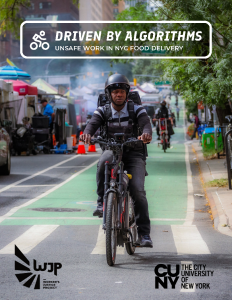 The brief, Driven by Algorithms: Unsafe Work in NYC Food Delivery, presents findings from a 2026 survey of 561 delivery workers. More than 80% of respondents said food delivery apps mostly or entirely determine how quickly orders must be completed, which routes workers take, and how many hours they work. To maintain high ratings, two-thirds said they rush to deliver on time, 56% said they work in bad weather, and 30% said they work even when they feel very sick.
The toll on workers’ health is substantial. Fifty-three percent of respondents reported a work-related injury, equal to 48 injuries per 100 full-time equivalent workers and more than five times the national rate for delivery messengers. Forty-six percent of all respondents reported an injury serious enough to require medical care or cause them to miss work and 30% said they lack health insurance. Forty percent met the criteria for severe psychological distress, five times the rate among adult New Yorkers and 10 times the rate among working-age adults nationally. Severe distress is a state of overwhelming mental burnout that requires urgent mental healthcare.
Many workers also face violence and theft on the job. Thirty-six percent have been physically assaulted while working, and 86% report theft of equipment or belongings, with losses averaging about $2,100.
“The toll we documented shows up both in injuries and in mental health,” said CUNY SPH Assistant Professor Mustafa Hussein, lead author on the brief. “More than half the workers we surveyed had been hurt on the job, and 40% have severe psychological distress. Understanding what drives those outcomes, including how the apps organize and monitor work, is essential to protecting the people who keep this city fed.”
Deactivation is a constant threat. Fifty-two percent of workers worried about being deactivated if they did not deliver fast enough. Seventy percent had contacted an app about a deactivation issue in the previous month, but only 37% of those workers said the issue was resolved satisfactorily. When asked what they most wanted to change about their jobs, 56% chose protection from deactivation, more than any other option. Workers were especially in favor of resolution of deactivation cases within 24 hours and 14 days’ advance notice before deactivation.
Losing access to the apps would be devastating for most of these workers, as nearly all depend on delivery income. Ninety-six percent said app delivery was their only job in the previous month, 98% earned at least half of their income from delivery, and 53% said delivery was their family’s only source of income.
“When an app can cut off a worker’s income with little explanation and no timely way to resolve it, that is a health issue as well as a labor issue,” said senior author Nevin Cohen, professor at CUNY SPH and director of the CUNY Urban Food Policy Institute. “Workers told us clearly what they need first: deactivation cases resolved within 24 hours and advance notice before they lose access to their jobs.”
“From an occupational health perspective, the risks these workers face are not limited to what happens on the street,” said senior author Sherry Baron, professor at the Barry Commoner Center for Health and the Environment at CUNY Queens College and an occupational health physician and researcher. “Intense work demands, little control over how the job is organized, and constant uncertainty about keeping access to work all shape workers’ health. They deserve the same attention as injuries and other more visible workplace hazards.”
“Delivery workers have long told us how much is at stake when an app can limit or end their access to work,” said co-author Ligia Guallpa, executive director of the Worker’s Justice Project. “These findings show how widespread those concerns are and why workers want a clear, timely process when deactivation occurs.”
About the study
The Delivery Work & Health Study examines the health and working conditions of platform-based food delivery workers in New York City. Worker’s Justice Project staff led participant recruitment between March and May 2026 across the five boroughs. Of 805 workers approached, 618 responded and 561 eligible workers consented and completed the survey. The survey was offered in French, Bangla, Spanish, and English. While the findings describe the workers surveyed and should not be interpreted as statistically representative of the entire citywide workforce, several of the study findings align with most recent data and anecdotal evidence on the composition and experience of the workforce.
The brief was prepared by Francesca Michielli, Mustafa Hussein, Sherry Baron, Nevin Cohen, Maria Figueroa, Ligia Guallpa, Emilia Vignola, Dana Calacci, Rositsa Ilieva, Yadira Sanchez, Zoey Laskaris, and Jacquelyn Sullivan. The study is a collaboration among CUNY SPH, the CUNY Urban Food Policy Institute, the Barry Commoner Center for Health and the Environment at Queens College, York College, the Worker’s Algorithm Observatory, the Worker’s Justice Project, and the Rockefeller Institute of Government.
The research was supported by the Robert Wood Johnson Foundation. The views expressed do not necessarily reflect the views of the Foundation.
The full data brief and a detailed chartpack are available at: https://cunyurbanfoodpolicy.org/resources/report/driven-by-algorithms/.
Media contact:
Ariana Costakes
Communications Editorial Manager
ariana.costakes@sph.cuny.edu
About Worker’s Justice Project
Founded in 2010, the Worker’s Justice Project (WJP) is a New York City worker center that educates, organizes, and fights for better work conditions and social justice in the workplace. With a base of more than 12,000 members, WJP organizes low-wage, immigrant workers who are fighting to raise workplace standards in the construction, house cleaning, and app-based delivery industries.
About CUNY SPH
The CUNY Graduate School of Public Health and Health Policy (CUNY SPH) is committed to promoting and sustaining healthier populations in New York City and around the world through excellence in education, research, and service in public health and by advocating for sound policy and practice to advance social justice and improve health outcomes for all.