About the Program
DELIVERY METHOD: HYBRID (ONLINE AND ON-CAMPUS) | FULLY ONLINE
ENROLLMENT TYPE: FULL-TIME | PART-TIME
SCHOLARSHIPS AVAILABLE

 CLOSE MENU
DELIVERY METHOD: HYBRID (ONLINE AND ON-CAMPUS) | FULLY ONLINE
ENROLLMENT TYPE: FULL-TIME | PART-TIME
SCHOLARSHIPS AVAILABLE
The MPH in Public Health Nutrition prepares students to promote the nutritional well-being of population groups by learning to assess the nutritional needs of various populations, planning and implementing nutrition and food programs and managing nutritional programs in community and institutional settings. The degree offers one curriculum for those who are Registered Dietitians (RDs) and another for those without this credential. To be considered, please contact Prof. Ghada Soliman at ghada.soliman@sph.cuny.edu.
Applicants who have completed an undergraduate Didactic Program in Dietetics (DPD) from an ACEND-accredited institution with a GPA of 3.0 or higher could be considered for the Dietetic Internship within the MPH in Public Health Nutrition at CUNY School of Public Health. To be considered, please contact Prof. Ann Gaba at ann.gaba@sph.cuny.edu.
The MPH in Public Health Nutrition is not a Didactic Program in Dietetics (DPD) as required by the Academy of Nutrition and Dietetics. For information about available DPD programs, please click here.
For students who began matriculating in Spring 2019 or earlier, please review the previous curriculum for the MPH in Public Health Nutrition here.
Delivery method: This program is offered in both hybrid (online and on-campus) and fully online formats. Online courses may be delivered asynchronously and/or synchronously. Current and recent school-wide class schedules, including modality details, can be found here. Find answers to common questions about our online programs and delivery methods here.

The program is designed for students who are passionate about public health nutrition science and the nutritional well-being of population groups. The degree offers one curriculum for those who are Registered Dietitians (RDs) and another for those without this credential.
Learn to scientifically assess dietary and nutritional needs and guidelines, examine how social and environmental factors impact access to nutrition on individual and population levels and design evidence-based nutrition policies and interventions with government agencies in mind.
Graduates work in hospitals, clinics, community programs, local, state, or federal government health departments and in international nutrition programs. They coordinate and analyze nutrition research and policies, direct nutrition programs and manage school food programs among other positions.

SOPHAS applications for Spring, Summer, and Fall 2027 are now open.

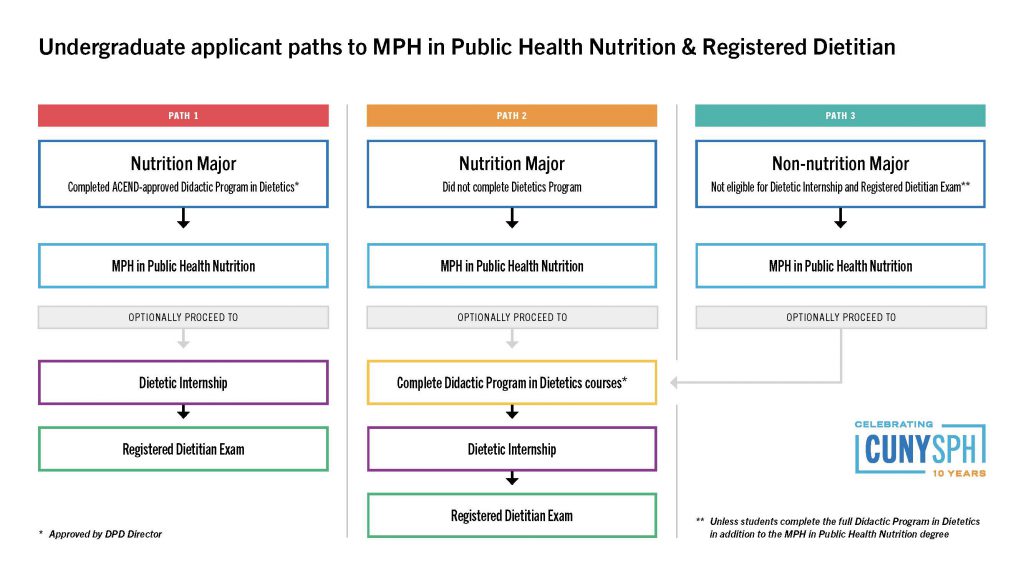
See undegraduate applicant pathways to an MPH in Public Health Nutrition & Registered Dietician certification here.
For students who began matriculating in Spring 2019 or earlier, please review the previous curriculum for the MPH in Public Health Nutrition here.
| Foundational Knowledge (0 credits) | PUBH 601 Foundations of Public Health Knowledge* |
| Core Coursework (15 credits) | PUBH 610 Introduction to Health Systems, Policy, and Management |
| PUBH 611 Health Equity, Communication, and Advocacy | |
| PUBH 612 Designing and Evaluating Public Health Interventions | |
| PUBH 613 Designs, Concepts, and Methods in Public Health Research | |
| PUBH 614 Quantitative and Qualitative Data Analysis Methods in Public Health Research | |
| Required Coursework (15 credits) | FNPH 620 Community Nutrition Education |
| FNPH 622 Food and Nutrition through the Lifecycle | |
| FNPH 820 Food Policy | |
| FNPH 623 Nutrient Metabolism and Applications in Public Health | |
| FNPH 624 Nutritional Epidemiology | |
| Elective Coursework (6 credits) | Two (2) electives chosen in consultation with faculty advisor |
| Practice Experience (3 credits) | PUBH 696 Supervised Fieldwork |
| Culminating Experience (3 credits) | PUBH 698 Capstone Project |
| Total Credits Required | 42 |
*Students who have a CEPH-accredited undergraduate or graduate degree in public health can be waived from PUBH 601 by submitting a Course Waiver Request.

These sequences are recommended for full-time students. Part-time students are encouraged to meet with a staff advisor to map out an appropriate plan of study.
For students who began matriculating in Spring 2019 or earlier, please review the previous course sequence for the MPH in Public Health Nutrition here
| Semester | Course | Credits |
| Year 1 Fall | PUBH 601: Foundations of Public Health Knowledge* | 0 |
| PUBH 613: Designs, Concepts, and Methods in Public Health Research | 3 | |
| FNPH 620: Community Nutrition Education | 3 | |
| PUBH 612: Designing and Evaluating Public Health Interventions | 3 | |
| PUBH 611: Health Equity, Communication, and Advocacy | 3 | |
| Year 1 Spring | PUBH 614: Quantitative and Qualitative Data Analysis Methods in Public Health Research | 3 |
| PUBH 610: Introduction to Health Systems, Policy, and Management | 3 | |
| FNPH 622: Food and Nutrition Through the Lifecycle | 3 | |
| Elective I | 3 | |
| Year 2 Fall | PUBH 696: Supervised Fieldwork | 3 |
| FNPH 820: Food Policy | 3 | |
| Elective II | 3 | |
| Year 2 Spring | PUBH 698: Capstone Project | 3 |
| FNPH 624: Nutritional Epidemiology | 3 | |
| FNPH 623: Nutrient Metabolism and Applications in Public Health | 3 |
| Semester | Course | Credits |
| Year 1 Spring | PUBH 601: Foundations of Public Health Knowledge* | 0 |
| PUBH 613: Designs, Concepts, and Methods in Public Health Research | 3 | |
| FNPH 622: Food and Nutrition Through the Lifecycle | 3 | |
| PUBH 611: Health Equity, Communication, and Advocacy | 3 | |
| PUBH 612: Designing and Evaluating Public Health Interventions | ||
| Year 1 Fall | PUBH 610: Introduction to Health Systems, Policy, and Management | 3 |
| PUBH 614: Quantitative and Qualitative Data Analysis Methods in Public Health Research | 3 | |
| FNPH 620: Community Nutrition Education | 3 | |
| Elective I | 3 | |
| Year 2 Spring | PUBH 696: Supervised Fieldwork | 3 |
| FNPH 623: Nutrient Metabolism and Applications in Public Health | 3 | |
| FNPH 624: Nutritional Epidemiology | 3 | |
| Year 2 Fall | PUBH 698: Capstone Project | 3 |
| FNPH 820: Food Policy | 3 | |
| Elective II | 3 |

For students who began matriculating in Spring 2019 or earlier, please review the previous competencies for the MPH in Public Health Nutrition here.
– Apply epidemiological methods to settings and situations in public health practice
– Select quantitative and qualitative data collection methods appropriate for a given public health context
– Analyze quantitative and qualitative data using biostatistics, informatics, computer-based programming, and software, as appropriate
– Interpret results of data analysis for public health research, policy, or practice
– Compare the organization, structure and function of health care, public health and regulatory systems across national and international settings
– Discuss the means by which structural bias, social inequities and racism undermine health and create challenges to achieving health equity at organizational, community and systemic levels
– Assess population needs, assets and capacities that affect communities’ health
– Apply awareness of cultural values and practices to the design, implementation or critique of public health policies or programs
– Design a population-based policy, program, project or intervention
– Explain basic principles and tools of budget and resource management (“Resource management” refers to stewardship (planning, monitoring, etc.) of resources throughout a project, not simply preparing a budget statement that projects what resources will be required.)
– Select methods to evaluate public health programs
– Discuss the policy-making process, including the roles of ethics and evidence (This competency refers to technical aspects of how public policies are created and adopted, including legislative and/or regulatory roles and processes, ethics in public policy making and the role of evidence in creating policy.)
– Propose strategies to identify stakeholders and build coalitions and partnerships for influencing public health outcomes
– Advocate for political, social or economic policies and programs that will improve health in diverse populations (This competency refers to the ability to influence policy and/or decision making, such as through stakeholder mobilization, educating policy makers, etc. Ability to argue in support of (or in opposition to) a position, as in a standard debate, is not sufficient. Students must produce a product that would be part of an advocacy campaign or effort (e.g., legislative testimony, fact sheets, advocacy strategy outline, etc.).)
– Evaluate policies for their impact on public health and health equity
– Apply leadership and/or management principles to address a relevant issue (Such principles may include creating a vision, empowering others, fostering collaboration and guiding decision making.)
– Apply negotiation and mediation skills to address organizational or community challenges (“Negotiation and mediation,” in this competency, refers to the set of skills needed when a common solution is required among parties with conflicting interests and/or different desired outcomes. Such skills extend beyond the level of negotiation required in a successful intra-group process; effective communication within a work group or team is more closely related to competency)
– Select communication strategies for different audiences and sectors
– Communicate audience-appropriate (i.e., non-academic, non-peer audience) public health content, both in writing and through oral presentation
– Describe the importance of cultural competence in communicating public health content
– Integrate perspectives from other sectors and/or professions to promote and advance population health (This competency requires direct engagement (in-person or online) between the student and an individual or individuals in a profession or sector other than public health; students must combine the external sector/profession’s perspective and/or knowledge with their own public health training to complete a task, solve a problem, etc.. Role-playing, in which public health students assume the identity of an individual from another profession or sector to which they do not already belong, is not an acceptable substitute for actual engagement with an individual or individuals from a profession or sector outside of public health.)
– Apply a systems thinking tool to visually represent a public health issue in a format other than standard narrative (Systems thinking tools depict or map complex relationships, demonstrating, for example, how component parts of a system interact with and influence one another. Examples include causal loop diagrams, systems archetypes, network analyses, and concept maps. Logic models and evidence tables are not sufficient to address this competency.)
– Apply a systems thinking tool to visually represent a public health issue in a format other than standard narrative (Systems thinking tools depict or map complex relationships, demonstrating, for example, how component parts of a system interact with and influence one another. Examples include causal loop diagrams, systems archetypes, network analyses and concept maps. Logic models and evidence tables are not sufficient to address this competency.)
– Apply concepts from relevant scientific disciplines, such as toxicology and physiology, to anticipate effects of environmental, occupational and nutritional exposures on both human health and overall planetary health

Alumni outcomes data was collected via surveys of CUNY SPH alumni one year after graduation from 2016 to 2022. See more program outcomes here.