
 CLOSE MENU
Artificial Intelligence in Action: AI Research and Projects
AIMINGS AI Center
NIH U54 grant (PI: Bruce Y. Lee) funded the creation of an AI Center, serving as the AI Center for the NIH Nutrition for Precision Health (NPH) consortium.
phicor.org/aimings

AI Tool Development: CUNY AI Navigator for Mental Health, Safety, and Health Insurance
Dr. Williams and colleagues will create an AI-powered navigator tool to help students understand and access CUNY-specific mental health resources, safety protocols, legal support, and health insurance information. The tool would be multilingual, culturally responsive, and built using only pre-approved CUNY documents, policies, and resource lists. By collaborating with Student Affairs, Legal Counsel, the Office of International Affairs, student organizations, and Communications, the project will gather accurate content to train the system responsibly. To ensure the tool reflects student needs, the team will conduct focus groups and interviews with up to 100 students, offering incentives. These sessions will explore students’ awareness, challenges, and preferences regarding mental health services, campus safety, legal supports, and understanding of health insurance. Findings will directly inform the design and functionality of the AI navigator, which can be integrated into a CUNY webpage for easy, centralized access.

Understanding Student Attitudes Toward AI to Develop an Ethical AI Literacy Module for CUNY SPH: Student Module for AI Readiness Training (CUNY SMART)
The rapid expansion of generative AI in academia and public health presents both opportunities and challenges for CUNY students, who currently lack structured support regarding responsible, ethical, and equity-centered use. CUNY SMART ultimately provides a practical, innovative, ethics-centered educational module to deepen students’ understanding of AI and create a replicable model for CUNY. The research team will assess student needs by conducting and analyzing focus groups with CUNY SPH students to understand their current AI usage, confidence, risks, benefits, and support gaps. Findings from will inform the creation of a comprehensive AI Literacy and Responsible Use Module tailored for CUNY student development and coursework.
Spring Cooper, Phil Kreniske

System Dynamics Modeling for Real Time Connections to Care
Applying AI to advance an evidence-based digital platform for communications with individuals with moderate to severe opioid use disorder, to link them with telehealth buprenorphine.
Nasim Sabounchi, collaborators from Yale University, and Center for Progressive Recovery

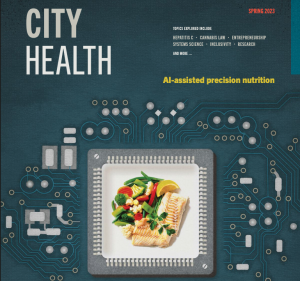
CUNY SPH City Health Magazine, Spring 2023
In the coming few years, an Artificial Intelligence (AI) center is poised to revolutionize nutrition by enabling the precise tailoring of dietary guidelines based on an individual’s genetics, biology, behaviors, social networks, environment and economic factors to better predict an ideal diet.
CityHealth-Spring 2023