 CLOSE MENU


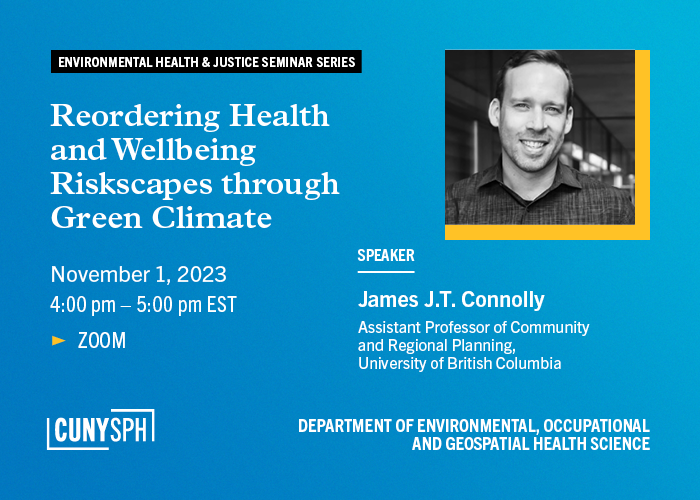
How do land-use-based climate strategies reorder the local geography of health and wellbeing risks for urban residents? In this talk, James Connolly argues that the answer to this question is more complicated than the one commonly presented in public discourse. If processes outlined within established “green gentrification” research continue as an engine for change in cities, then urban climate interventions cannot be understood as simple risk reduction actions. Rather, they have to be seen as actions that reorder the spatial dimension of risk – or, in other words, create a new riskscape pattern – within cities. This reordering occurs specifically because of interactions across social and ecological risks. Connolly will outline these interactions based on his recent research and discuss what this way of thinking about planning interventions means for the practice of planning for green climate urbanism.
About the speaker
James J.T. Connolly is an Assistant Professor of Community and Regional Planning at the University of British Columbia and the former Co-Director of the Barcelona Lab for Urban Environmental Justice and Sustainability at the Universitat Autònoma de Barcelona (UAB) within the Institute of Environmental Sciences and Technology (ICTA). His research interests focus on the intersection of urban greening and social justice, with a focus on processes of green gentrification, climate risk, and the politics of urban transformation.
This lecture is part of the Environmental Health and Justice Seminar Series, presented by the Department of Environmental, Occupational and Geospatial Health Sciences.