 CLOSE MENU


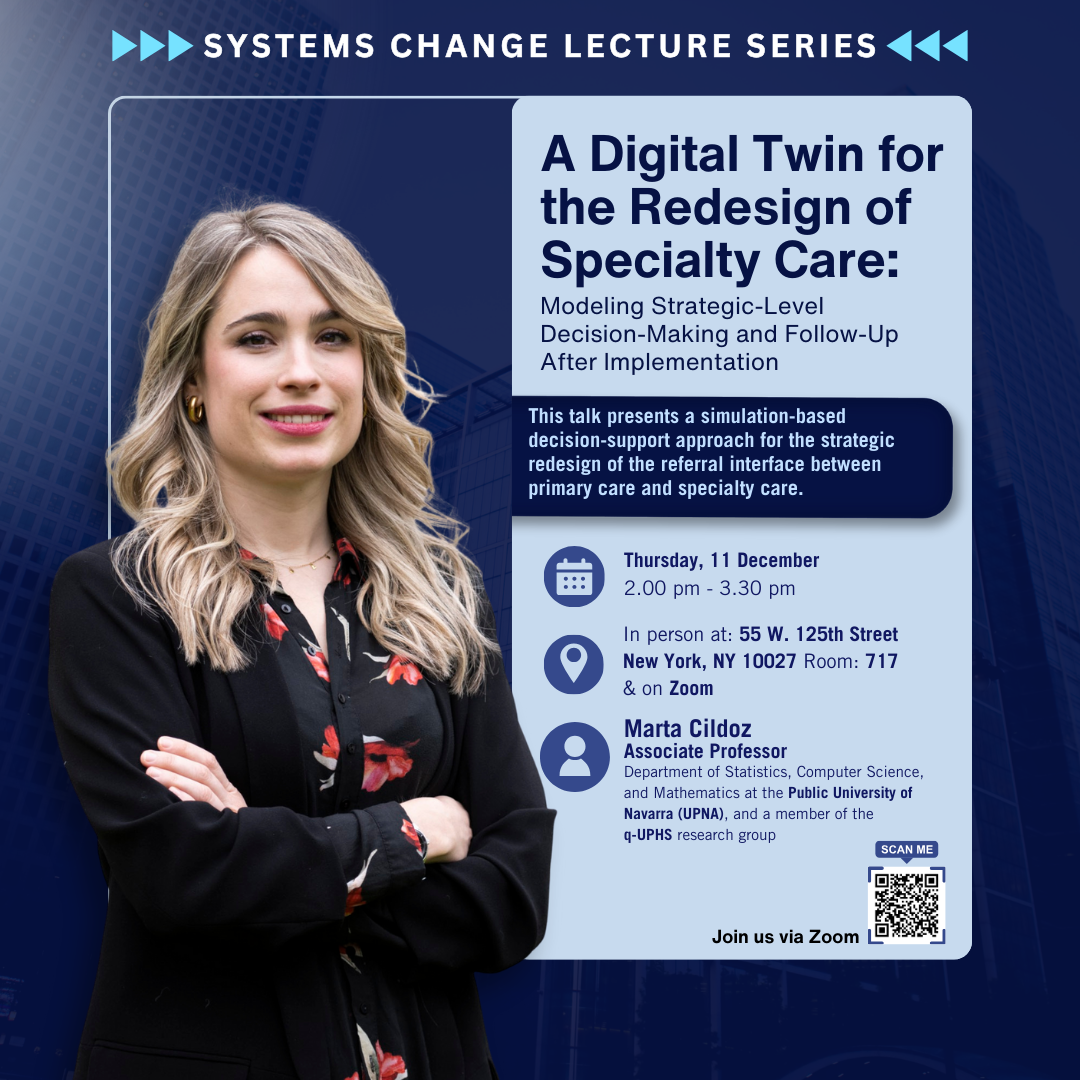
The CUNY SPH Center for Systems and Community Design presents the next Systems Change Lecture Series on December 11, 2025.
Those interested can attend in person at the CUNY SPH campus, 55 West 125th Street, Room 717, New York, NY 10027. Or virtually via Zoom.
For more information, visit the link.
This month’s topic will be, “A Digital Twin for the Redesign of Specialty Care: Modeling Strategic-Level Decision-Making and Follow-Up After Implementation,” by Marta Cildoz, associate professor in the department of statistics, computer science, and mathematics at the Public University of Navarra (UPNA).
This talk will present a simulation-based decision-support approach for the strategic redesign of the referral interface between primary care and specialty care.
ABSTRACT
Long waiting lists for specialty care remain a persistent challenge, particularly in trauma services. This talk presents a simulation-based decision-support approach for the strategic redesign of the referral interface between primary care and specialty care, together with the reorganization of internal pathways in the Traumatology Service of the University Hospital of Navarra (Spain).
A data-driven, discrete-event simulation model, built from real patient records and initialized at the current system state, is used to examine the system’s transient response to proposed changes. The analysis focuses on key performance indicators, including the number of consultations per patient, physician workload, and waiting list reduction, and examines how alternative referral behaviors by primary-care physicians influence overall performance. Results show that the model provides evidence to inform strategic decisions and offers a pathway toward a digital twin for continuous improvement and operational planning.
Following implementation of the new configuration, a follow-up study has analyzed real patient flows to validate the simulated predictions. We report observed patterns of system use and referral behavior under the new design, and offer insights into current performance and sustainability.
ABOUT THE SPEAKER:
Marta Cildoz is an associate professor in the department of statistics, computer science, and mathematics at the Public University of Navarra (UPNA) and a member of the q-UPHS research group, which applies operations research to healthcare management.
Her research integrates simulation, optimization, and data-driven analytics to improve decision-making in healthcare, with emphasis on patient-flow management, resource allocation, and workforce scheduling. She has collaborated with institutions including the Government of Navarra’s Health Department and the University Hospital of Navarra in multidisciplinary teams, developing practical solutions that support strategic and operational decision-making. She has participated in multiple research projects funded by national and European programs, contributing methodological advances in healthcare operations research with tangible impact on real-world healthcare management and policy.